
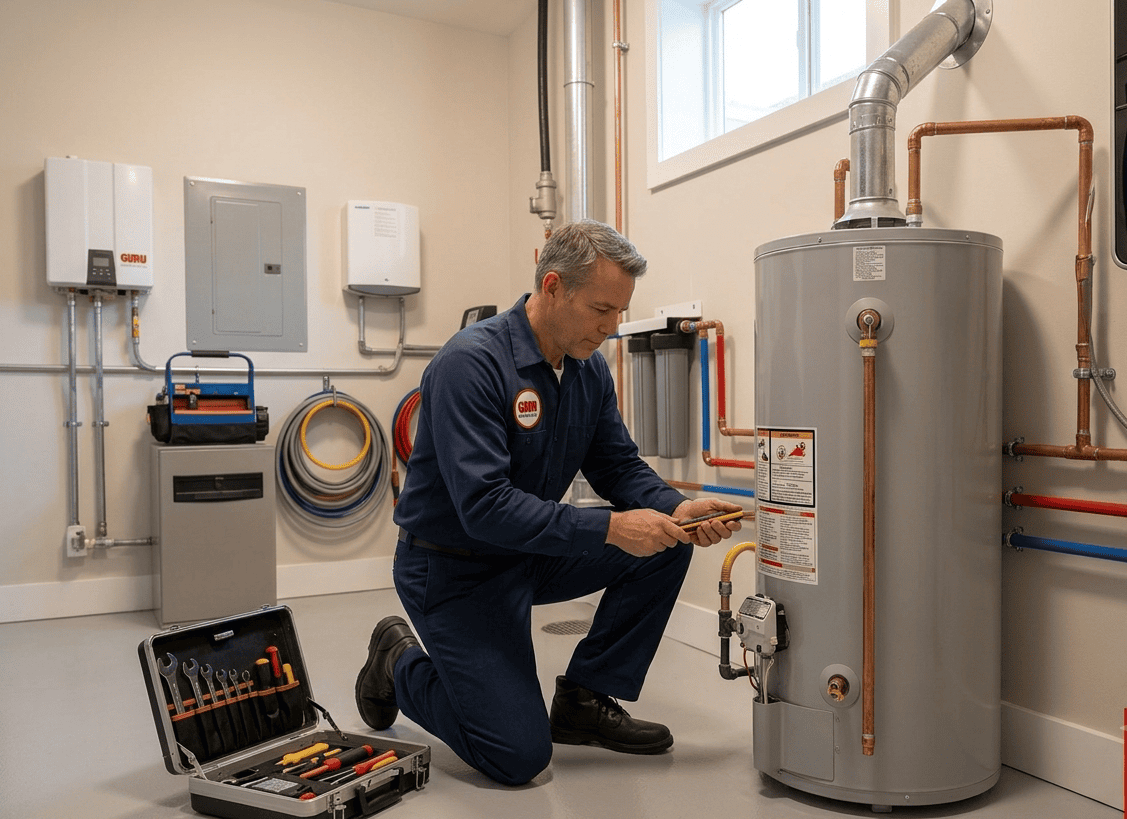
If your gas water heater keeps going out, you’re not alone — it’s one of the most common service calls we get from homeowners across Surrey, Cloverdale, and Delta. A gas water heater that repeatedly shuts off is almost always caused by one of seven issues: a faulty thermocouple, a dirty pilot orifice, a failing gas control valve, poor venting, thermostat problems, a tripped safety switch, or gas supply issues. Most are fixable, but a few signal a safety risk that needs a licensed professional immediately.
At Guru Plumbing & Heating, we’ve repaired hundreds of natural gas water heaters Surrey throughout Metro Vancouver, and Surrey’s older housing stock — combined with our damp coastal climate — creates the perfect conditions for these failures. Here’s what’s actually going wrong, how to tell the difference, and when it’s time to pick up the phone.
1. A Faulty Thermocouple (The #1 Cause)
The thermocouple is a small copper rod that sits in the pilot flame. Its job is simple but critical: it senses heat from the pilot and tells the gas valve it’s safe to keep the gas flowing. When the thermocouple wears out, corrodes, or gets misaligned, it can’t detect the flame properly — so the safety valve shuts off gas to the entire unit, even though the pilot may look fine.
How to spot it: The pilot lights but won’t stay lit after you release the control knob, or it goes out within a few minutes to a few hours.
The fix: Thermocouples are inexpensive parts, but replacing one correctly means shutting off the gas supply, disconnecting the old thermocouple, and precisely repositioning the new one in the pilot flame. In our experience, misaligned replacement thermocouples are the single most common reason a DIY fix doesn’t hold — even a few millimetres off, and the pilot won’t stay lit.
2. A Dirty or Clogged Pilot Orifice
Over years of use, dust, lint, and mineral sediment can clog the tiny pilot orifice, starving the flame of gas and causing it to burn weak, small, or with a yellow (rather than blue) tip. A starved flame won’t generate enough heat to satisfy the thermocouple, and the unit shuts down as a safety response.
How to spot it: The pilot flame looks small, flickering, or yellow instead of a steady blue.
Note: A yellow or orange pilot flame can also indicate incomplete combustion, which produces carbon monoxide. This isn’t a DIY cleaning job — it needs a professional inspection.
3. A Failing Gas Control Valve
The gas control valve regulates gas flow to both the pilot and the main burner, and it houses the thermostat and safety sensors. When this component starts to fail internally, it can cause intermittent shutoffs that seem to have no pattern — the pilot lights, holds for a while, then randomly cuts out.
How to spot it: The pilot stays lit fine sometimes, then goes out at random for no obvious reason, or the water temperature has become inconsistent.
The fix: Gas control valves aren’t user-serviceable. They must be replaced as a full unit by a licensed gas fitter, and in BC, gas appliance work legally requires a certified technician under the BC Safety Authority’s regulations.
4. Venting and Draft Problems
Surrey’s wet fall and winter months bring wind, rain, and debris that can affect a water heater’s venting system. If the vent is blocked, damaged, or improperly installed, a backdraft can blow out the pilot flame or trigger the unit’s flame sensor to shut off gas as a safety measure.
How to spot it: The pilot goes out specifically during windy weather, or you notice soot or moisture around the vent connections.
Why this matters more in Surrey: Homes built before the 2000s often have older Category I venting systems that are more susceptible to backdrafting than modern power-vent designs. If your water heater is vented through an exterior wall or an older chimney liner, this is worth checking first.
5. Thermostat Malfunction
If the thermostat that controls the main burner malfunctions, it can misread water temperature and shut the system down as a protective measure, even while the pilot stays lit. This is different from a pilot outage — the flame stays on, but the burner won’t fire, or the unit displays an error and locks out.
How to spot it: The pilot light is on and steady, but you’re getting no hot water or inconsistent temperatures.
6. A Tripped High-Limit or ECO Safety Switch
Most gas water heaters have an Energy Cut-Off (ECO) switch, sometimes called a high-limit switch, that shuts the whole unit down if the water temperature or the temperature at the top of the tank gets dangerously high. Once tripped, some units require a manual reset — and if it keeps tripping repeatedly, it usually points to a deeper issue like sediment buildup insulating the temperature sensor from the actual water, or a stuck gas valve overheating the tank.
How to spot it: The unit stops working entirely, sometimes after unusually hot water, and a reset button on the thermostat needs to be manually pressed.
Important: A high-limit switch that keeps tripping is a warning sign, not something to keep resetting. Repeated resets on a genuine overheating fault can be a fire and burn-scald hazard.
7. Gas Supply Issues
Occasionally, the cause isn’t the water heater at all — it’s the gas supply. A partially closed gas shutoff valve, a kinked flexible gas line, or low gas pressure from the utility can all starve the pilot and main burner of fuel, causing outages that look identical to an internal component failure.
How to spot it: Other gas appliances in the home (stove, furnace) are also acting up, or the water heater was recently serviced, and the shutoff valve wasn’t fully reopened.
When to Call a Professional vs. When It’s DIY
Relighting a pilot light following the manufacturer’s instructions on the tank is generally safe for homeowners to attempt. But you should stop and call a licensed plumbing company Surrey if:
- The pilot won’t stay lit after two or three relight attempts
- You smell gas (rotten egg odour) at any point — leave the home and call the gas utility emergency line immediately
- The flame is yellow, orange, or flickering rather than a steady blue
- You see soot, scorch marks, or moisture around the vent or flue
- The unit is more than 10-12 years old and has needed repeated repairs
Gas appliance repairs in British Columbia must be performed by a licensed gas fitter under provincial safety regulations — this isn’t just best practice, it’s the law, and it’s what keeps your home and family safe from carbon monoxide exposure or fire risk.
How Long Should a Gas Water Heater Last?
Most gas water heaters in the Lower Mainland last 8 to 12 years, though hard water and sediment buildup — common throughout Surrey and Metro Vancouver — can shorten that lifespan if the tank isn’t flushed annually. If your unit is approaching or past the 10-year mark and experiencing repeated shutoffs, repair costs can quickly approach the cost of replacement. We always give homeowners an honest repair-vs-replace recommendation rather than pushing a sale.
Preventing Future Outages: Maintenance Tips
- Flush the tank annually to remove sediment that insulates the burner and stresses the thermocouple and ECO switch.
- Inspect the venting each fall before BC’s rainy season sets in, especially on older Category I vented units.
- Keep the area around the water heater clear of dust, lint, and stored items that can clog the pilot assembly or restrict combustion air.
- Schedule annual professional maintenance — a licensed plumber in Surrey can catch a failing thermocouple or gas valve before it leaves you without hot water on a cold morning.
- Know your unit’s age. Check the manufacture date on the rating plate; anything past year 10 deserves a closer look during your next service visit.
Don’t Wait for a Cold Shower — Get It Fixed Right the First Time
A gas water heater that keeps going out won’t fix itself, and every relight attempt on a genuinely faulty unit adds risk. The licensed technicians at Guru Plumbing & Heating diagnose the real cause the first time, carry the parts to fix most issues on the spot, and serve homeowners throughout Surrey, Cloverdale, Delta, and across Metro Vancouver.
Call or book an appointment online today for a fast, honest diagnosis of your gas water heater — because hot water shouldn’t be a gamble.
Frequently Asked Questions
Is it dangerous if my water heater's pilot light keeps going out?
It can be. A yellow or flickering flame, soot around the vent, or a gas odour are all signs of a potential carbon monoxide or gas leak risk. If you notice any of these, turn off the gas supply and call a licensed plumber immediately rather than continuing to relight it.
How much does it cost to fix a gas water heater that keeps shutting off?
Costs vary depending on the cause — a thermocouple replacement is typically the most affordable fix, while a gas control valve replacement costs more since the entire valve assembly must be replaced. We provide upfront, transparent pricing before any work begins.
Can I fix a gas water heater pilot light problem myself?
Relighting the pilot following the manufacturer's label is usually safe to attempt. However, diagnosing and replacing internal components like the thermocouple or gas control valve involves working with live gas lines and should be left to a licensed gas fitter for safety and code compliance.
How often should a gas water heater be serviced?
We recommend annual maintenance, including a tank flush and a full inspection of the pilot assembly, venting, and gas connections. This is especially important in Surrey's damp climate, which accelerates corrosion in venting components.